Background The project took place in Comuna 10 of Pasto, a marginalised urban sector where displaced families from rural and conflict-affected areas face precarious living conditions. Due to their limited skills, the community often depends on informal labour or domestic work, with little access to state services. The environment is marked by violence, drug trafficking, and insecurity. Women in particular carry the weight of sustaining households, frequently as single mothers or grandmothers raising grandchildren, while enduring domestic violence and social isolation.
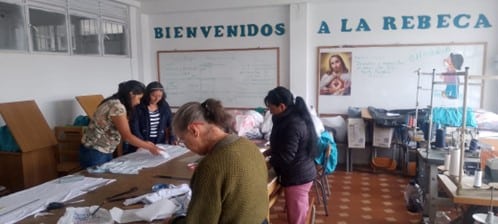
Activities In response, the workshop project Mujeres embarcadas en La Rebeca para tejer sus sueños (Women aboard La Rebeca, weaving their dreams) provided tailoring training with income generation to 18 women while also providing affordable school uniforms for 80 vulnerable families. Weekly meetings with the four women of the Sicomoro Group served as spaces for planning new production lines and reflection. Training workshops were conducted on the new production lines such as waterproof uniforms, winter jackets, blouses, and t-shirts. Additional sessions taught participants how to use family sewing machines. The project also invested in equipment, including sewing machines, storage units, and tools, which improved the organisation and efficiency of the workshop.
Results The outcomes were significant despite challenges. The group developed four new product lines, enhancing both the quality and variety of uniforms. Better equipment enabled the workshop to host more women and students for training in sewing and garment-making. Affordable uniforms were made available to local children, reducing financial strain on vulnerable families. Participants gained skills, greater self-confidence, and the possibility of generating income, while new groups began forming around self-care and crafts. Some women reported being able to attend more regularly thanks to transport support, while the improved workshop environment fostered a stronger sense of community. Although attendance fluctuated due to women’s multiple responsibilities, the project created real opportunities for skill-building and solidarity. The seeds of sustainability were planted through partnerships with local artisans, schools, and the Autonomous University of Nariño, which opened pathways for technical training in sewing and tailoring. Ultimately, the initiative strengthened women’s capacity to support their families, while weaving together spaces of encounter, learning, and dignity in a vulnerable community.
People being served
People being served : Women
Age group : [display_acf_checkbox field="age_group"]
Number of participants : 05-50
Schedule
Project status : Completed
Collaborations
Images
Training in T-shirt design and production
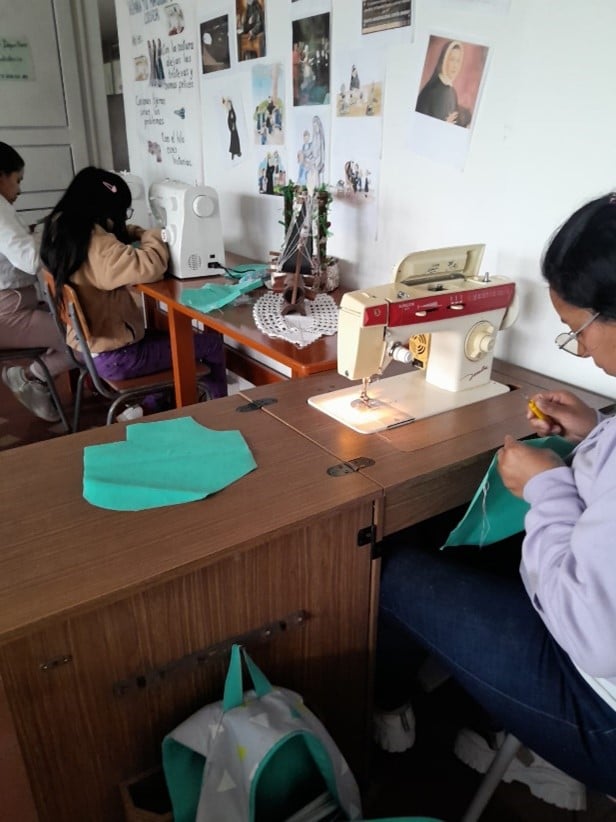
Trainees with the new friendly-user machines
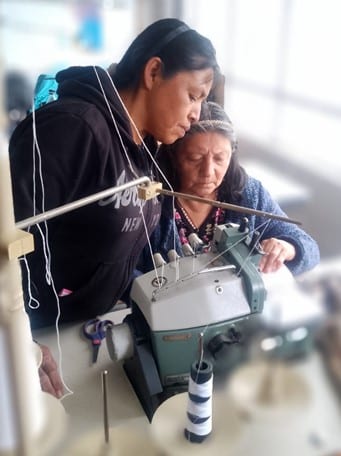
The new overlock sewing machine
Overview
Society presence : Colombia
Focus of the project : Social inclusion / reintegration
JPIC Imperative : Transforming and Being Transformed
UN Sustainable Development Goals :