Background
The association Ashankur is situated in the Ahmednagar District that is known as an area that has often suffered from drought. The main occupation of the people is agriculture which depends so much on the regularity of the monsoon. As a result the people are driven to take big loans to make a living. The money lenders exploit the people. Bank loans are available but as many of them have been defaulters, banks are reluctant to give big loans.
Ashankur, which means "Shoots of Hope," focuses on the empowerment of marginalised women in Bhokar. Some of the major barriers to the empowerment of women are illiteracy, lack of control over resources and non-participation in decision-making.
Ashankur has been building up a grass-roots movement where rural women initiate attitudinal changes towards themselves. It organises them in the formation of Self-Help Groups (SHG). It enables them to increase their control over decisions affecting their lives both within and outside their households.
Objective
The general aim of Ashankur is the empowerment of women where it encourages women to take decisions concerning their lives. Specific objectives include:
-
a change from household seclusion to social interaction,
-
a change from the humdrum routine of daily tasks to income-generating activities,
-
a change from a lack of active participation to equal rights in decision-making,
-
a change from the lack of control to control over resources.
Activities
-
The creation of Self-Help Groups (SHG): SHGs include 10-20 women per group. The groups are self-governed and it members make decisions about various village issues and production-oriented, income-generating activities. SHG members meet on a monthly base in their village and SHG representatives meet quartely with other SHG represeatives in Bhokar. Meeting of SHG include literacy classes.
-
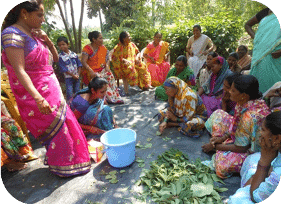
Organic farming: Training programs for marginalised farmer couples on an experimental basis. Training focuses on the following areas: mushroom cultivation, vermi composting, goat rearing, poultry, dairy, soya processing, rabbit rearing
-
Micro credit: micro-finance programs have been launched to help the women in the SHGs get organised and familiar with managing money. Women save and share small sums of money. They are guided as they develop a demonstrable track record with the money lent to them (accounting). This track record can then be used by the SHGs to obtain financing from more traditional institutional micro-finance institutions. Typically, Rs. 50 (80 Cent) or Rs. 25 (40 Cent) every month is contributed by every woman member of the group. It is collected together and put in the bank. The group is taught to manage their own money, to write accounts, to go to the bank, to deposit the money and then they start internal lending.
-
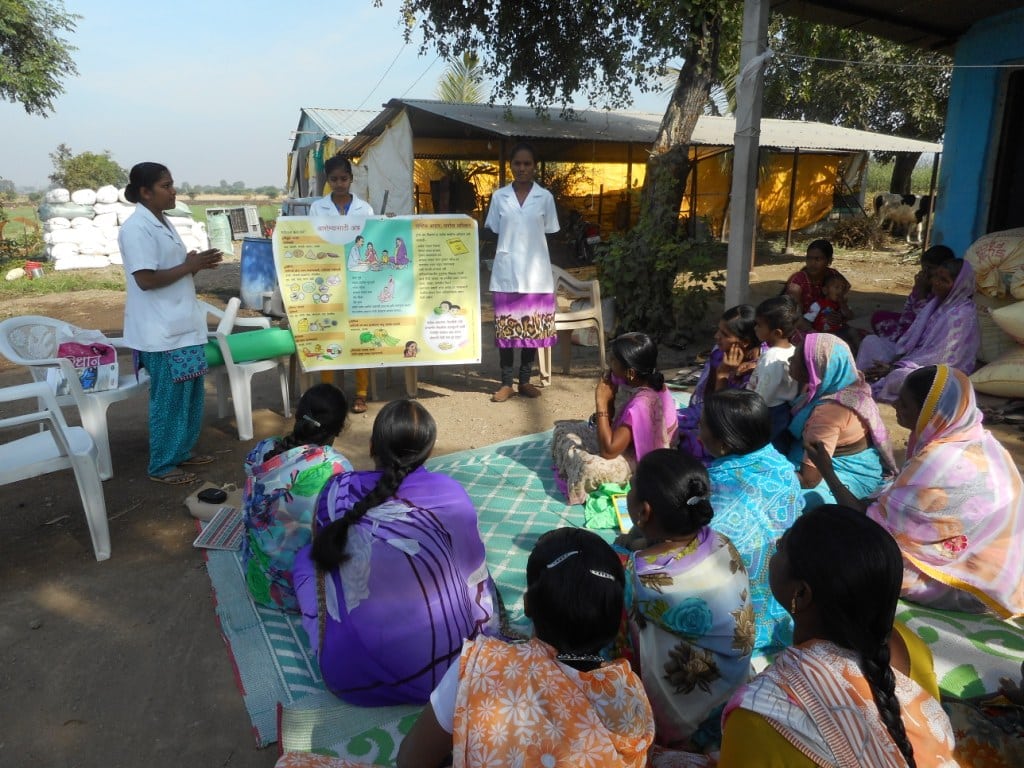
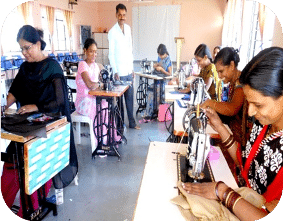
Skill training: Tailoring (garments); Nurses Aid Training: theory and practical experience
Results
-
Self-Help Groups: It has built communal harmony and minimised the effects of the caste system. Whereas social interaction and sharing of resources are natural consequences of such meetings, self-reliance and positive self-image are added advantages. Groups have begun to think about the dowry system, and related problems are now brought up for discussion. Women are now accustomed to visiting Gram panchayat or government offices and are able to demand their rights. Men have started commenting that because of the women's organizations in their villages, Panchayat Samitee (Local self-government) has begun to link their programs with the villages, and the quality of life in the villages is improving. The literacy classes have helped to bridge caste-based misconceptions among women as well as the economic homogeneity (and not on caste/religion structures). Women themselves have realized that due to literacy and information there is much more respect for them in the family. Wife beating is decreasing in some villages.
-
Organic Farming: Besides convincing the couples about the value of organic farming, this has encouraged gender equality in the functioning and running of the agricultural activities of the farmers.
-
Micro-credit: this program has given women confidence; it has helped them to get out ot the clutches of money lenders. It has develop as a platform to express solidarity among women. The economic power and group support has given women dignity and bargaining power in society. Women have learnt to take decisions of how to use their own money and to support each other. This gave them tremendous joy and satisfaction of owning their own earnings.
-
Skill taining: Families are now getting used to women going for overnight training sessions. Tailoring students making school uniforms for a nearby Jesuite school. Nursing courses enrolled in official nurse cours.
-
The overall community attitude towards women has changed positively.
People being served
People being served : Women
Age group : Adults 26-60, Children 0-17, Young people 18-25
Number of participants : >500
Schedule
Project status : Ongoing
Images
Overview
Society presence : India
Focus of the project : People
JPIC Imperative : Transforming and Being Transformed
UN Sustainable Development Goals :